How to Tell When Your Solar System Is Not Working Properly
Modern solar systems for villas and small commercial properties are designed to operate continuously for decades and rarely require much of attention. However, even the most reliable system is still exposed to time, tropical weather, and simple bad luck. As a result, deviations can occur – from harmless panel contamination to major inverter faults.
The main challenge is that property owners cannot always judge how serious a problem really is. Say, the system began producing slightly less energy, or the inverter occasionally displays errors, yet everything still appears to work, or the monitoring app shows rare dips in output. How bad is it? Is it time to call the service? Not necessarily. Solar systems constantly react to weather conditions, grid instability, dust, fallen leaves, and even new shade from a recently planted palm tree. The key is distinguishing normal fluctuations from actual faults.
Let us break this down. Below is a checklist of common symptoms and possible causes that can help owners understand when professional diagnostics are necessary.
Why Lower Energy Production Does Not Always Mean Something Is Broken
The main indicator of system health is energy generation. However, there are several perfectly normal reasons why production may fluctuate:
- Seasonality. During the summer months, days are longer, but increased cloud cover during the rainy season significantly reduces solar generation. In winter, the dry season typically provides clearer skies, resulting in higher energy production. Comparisons should be made between the same months in different years rather than between individual days.
- Clouds and haze. Dense storm clouds can reduce output by 80-95%, while light cloudiness may cause a 10-25% drop. Haze, smoke from agricultural burning, and high humidity also affect solar generation.
- Rain and self-cleaning. Heavy rain naturally washes and cools the panels, and generation may temporarily increase afterward. Dust gradually accumulating on the surface reduces output over time.
- Temperature. Solar panels become less efficient in hot weather. For every degree above 25 °C, panel output typically decreases by 0.3-0.5%. On extremely hot days, the inverter may temporarily limit power output to protect its electronics from overheating. High temperature alone is not considered a fault, although it can accelerate component aging.
- Normal degradation. Solar panels naturally lose some capacity over time. A degradation rate of 1% during the first year and approximately 0.4% annually afterward is considered normal. A yearly decline of 5-10% should be investigated.
These fluctuations by themselves usually mean nothing. The real warning signs are persistent deviations without an obvious explanation: the system consistently produces less energy under clear sunlight, the inverter regularly reports errors, or the system behaves differently than before.
What You Can Check Yourself
- Compare current generation with the same month last year.
- Check whether the shape of the production curve during a sunny day has changed.
- Look for new shade from trees, awnings, or nearby buildings. Foreign objects on the panels, such as fallen palm fronds or leaves, can shade multiple panels at once.
- Make sure the inverter is not displaying errors or warnings.
- Verify that monitoring data is updating correctly.
- Pay attention to unusual heat, fan noise, or burning smells.
Checklist of Common Solar System Problems
Generation and Monitoring

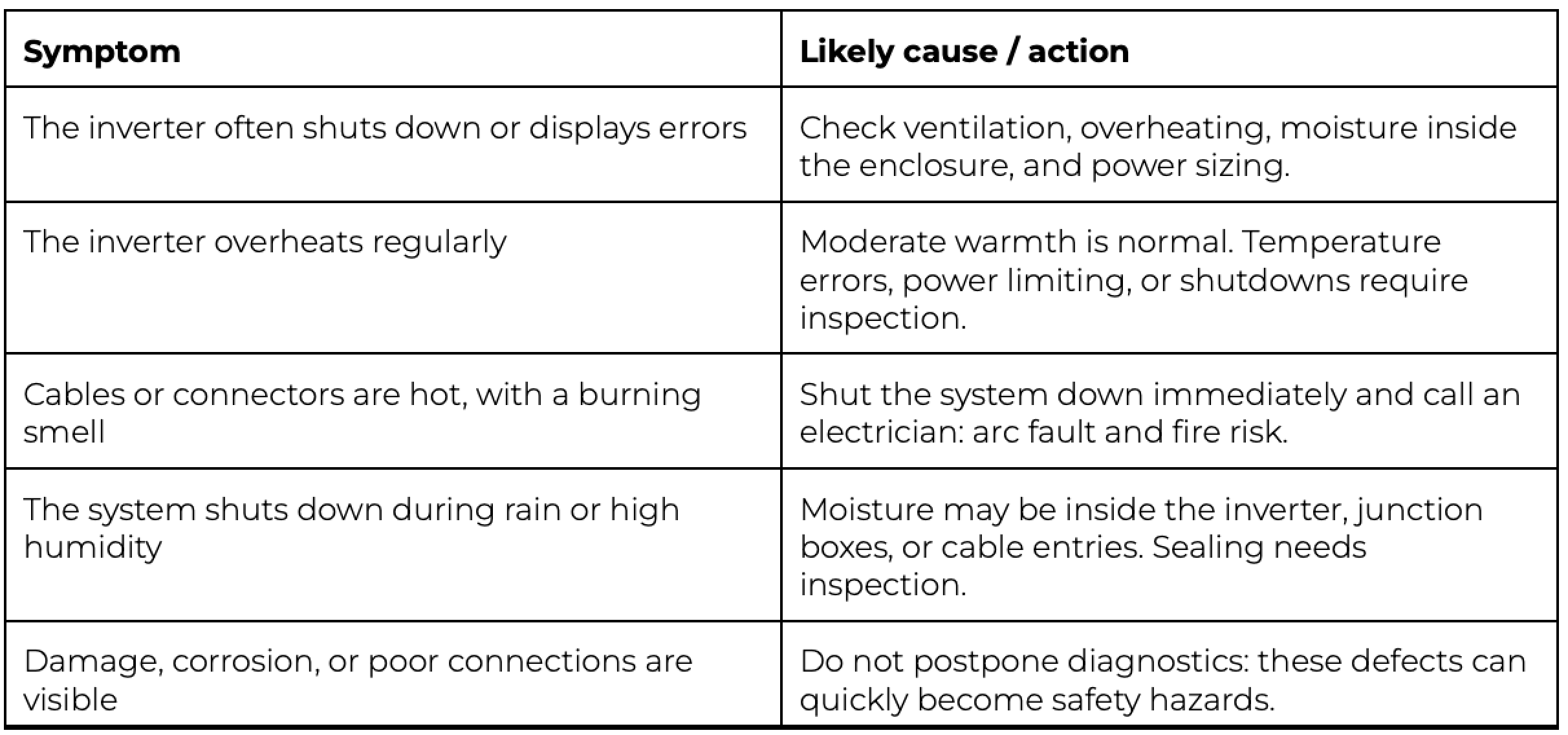
Inverter, Cables, and Safety
When Professional Diagnostics Are Necessary
- Annual generation has dropped by more than 10% and the decline cannot be explained by weather or seasonality.
- Repeated inverter errors appear: overheating codes, grounding faults, or arc fault warnings. Frequent errors should never be ignored – they are often early signs of more serious failures.
- Burning smells, excessive heat, or visible damage appear on cables or connectors. This is a serious fire hazard and the system should be shut down immediately.
- One or several panels suddenly show zero generation, especially in systems with microinverters or optimizers. This usually indicates an electronics failure.
- Production curves become abnormal, with unexpected midday dips or without the typical bell-shaped profile. This may indicate incorrect string configuration or MPPT issues.
- The system is older than 10-15 years and declining performance is becoming noticeable. Younger systems should generally undergo preventive inspections every 3-5 years, older ones should be checked annually.
- The installation was performed by a questionable contractor or purchased as a poorly engineered “turnkey” package. Verifying installation quality, cable connections, and string configuration can help identify hidden problems.
Common Installation Mistakes That Must Be Corrected
- Poor connections and incompatible connectors. Connectors from different vendors may appear compatible but often have different tolerances. Mixing them compromises sealing, leading to corrosion, overheating, and eventually fire. Damaged or poorly crimped connectors may spark and often appear blackened or melted.
- String mismatch. If panels with different electrical characteristics or different shading conditions are connected within the same string, the performance of the entire string decreases because it operates according to the weakest module.
- Insufficient inverter ventilation. If the inverter is installed under direct sunlight or inside a hot, poorly ventilated attic, it will constantly overheat and fail prematurely. Temperatures above 65 °C rapidly degrade capacitors.
- Undersized inverter capacity margin. When an inverter continuously operates at 95-100% of rated capacity, thermal stress increases and service life shortens.
- Poor moisture protection. Moisture enters through improperly sealed cable glands, causing corrosion and short circuits inside the inverter.
- Incorrect tilt angles and self-shading. If panel rows are installed too close together, they may shade one another. Incorrect tilt angles also reduce annual generation.
Conclusion
Proper solar system diagnostics always begin with ruling out normal factors: seasonality, cloud cover, temperature, and natural equipment aging. After that, the simplest and most likely causes should be checked first – contamination, shading, monitoring issues, connector condition, and inverter ventilation. Only then does it make sense to investigate internal equipment faults.
Regular monitoring helps identify deviations before they develop into serious failures. High-quality installation, proper system configuration, and adequate equipment ventilation remain the key conditions for the long-term, safe operation of a solar energy system.
Request a consultation
Tell us about your property: number of buildings, approximate size, and your goals for autonomy and comfort. We will propose a solution with clear KPIs and no unnecessary engineering complexity.