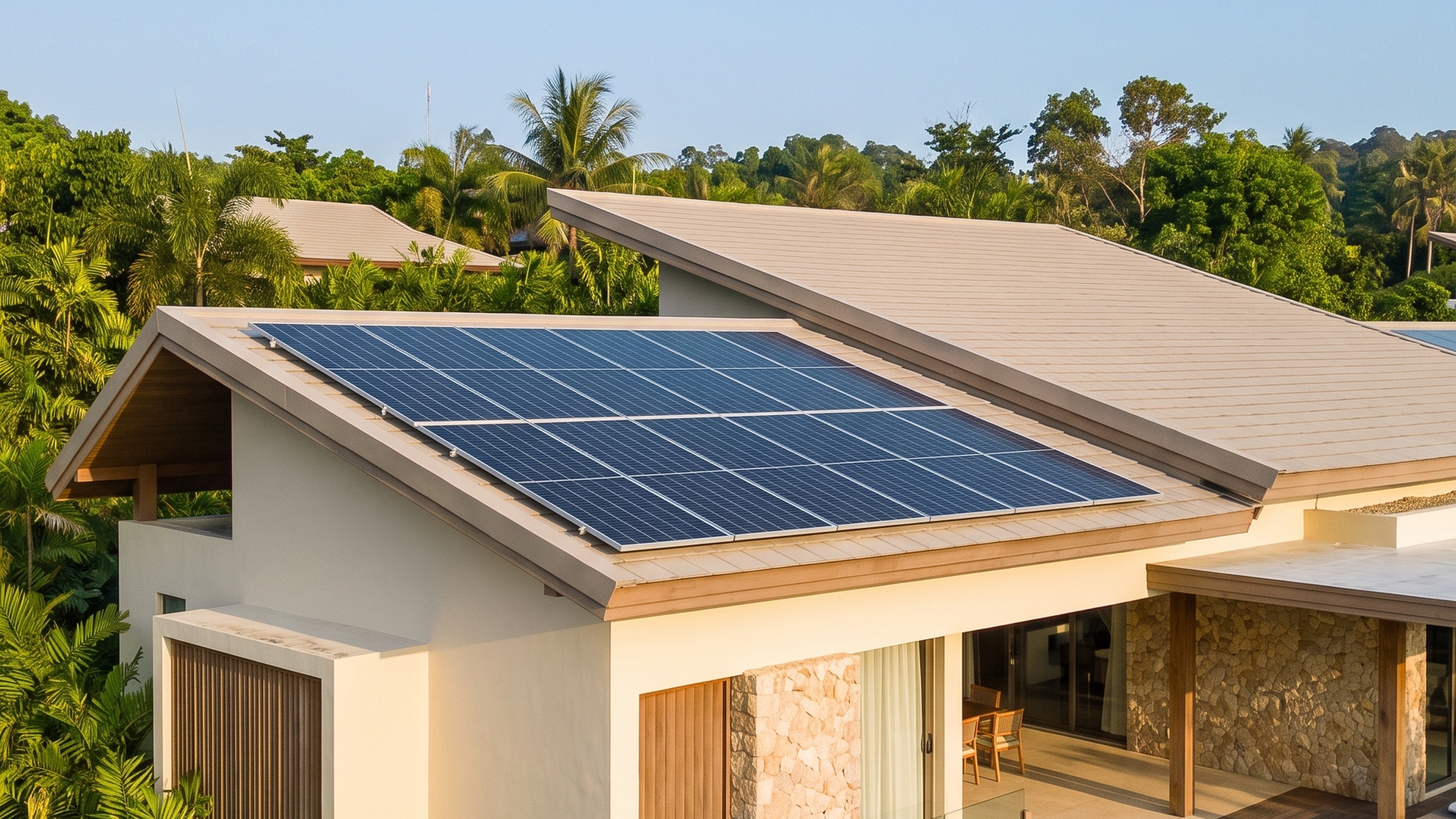
Should a Solar System Be Designed with Extra Capacity?
In the early stages of solar system design, engineers will usually be interested in your electricity bills and also in your plans for the next 5-10 years. This is not just a formality. The solar power system is expected to operate for 25 years or more, and your home’s energy consumption is unlikely to remain unchanged throughout that period. You may purchase an electric vehicle, build a swimming pool or a guest house, add more air conditioning units, or start working from home – all of these will increase electricity demand. Often, simply having access to free solar energy encourages homeowners to use more electricity, and overall consumption ends up increasing over time. Even if none of these plans exist today, your circumstances may look very different a few years from now.
This raises an important design question: should additional capacity be included from the beginning, or is it more practical to size the system for current needs and expand it later? The answer depends on a number of factors. In this article, we will examine the most important ones.
What Drives Future Energy Consumption?
Electric Vehicles
In Thailand today, an electric vehicle is often the main reason to reconsider the size of a solar system.
A typical EV consumes approximately 400 kWh per month, which amounts to up to 5 MWh per year. Offsetting that consumption requires roughly 5-10 additional panels rated at 450-650 W each.
Also, a typical Level 2 home charger draws approximately 7-11 kW while charging. This affects home’s load profile. If say charging takes place during the day while air conditioners, pool pumps, and other electrical loads are operating, the solar system must be capable of supporting this additional demand. As a result, system design must consider the maximum power demand the home may require during specific hours of the day – that’s in addition to annual energy consumption,.
However, EVs are often charged in the evening or at night, when solar panels are not producing electricity. In such cases, simply increasing the size of the array will not solve the problem. To make effective use of solar energy, charging must either be shifted to daytime hours or supported by a battery storage system.
Air Conditioning and Home Expansion
As we have discussed in previous articles, air conditioning is the single largest contributor to electricity consumption in hot climate.
Depending on its capacity and operating schedule, a central air conditioning system may consume 10,000 kWh per year or more:
- 9 000 BTU/h – 6-8 kWh per day
- 12 000 BTU/h – 8-10 kWh per day
- 18 000 BTU/h – 12-16 kWh per day
- 24 000 BTU/h – 16-20 kWh per day
- 36 000 BTU/h – 24-30 kWh per day
Even a single additional air conditioning unit can add a noticeable load.
Swimming Pools and Additional Facilities
Swimming pools are often viewed as a secondary load, yet their impact on overall electricity consumption can be substantial.
A single-speed pool pump rated at 1.5-2.0 kW consumes 12-16 kWh during an 8-hour operating cycle. This corresponds to 4-6 MWh per year.
If the pool uses electric heating or a heat pump, energy demand increases even further. In some cases, pool heating can consume more electricity than the entire house.
Home Extensions and Additional Buildings
Suppose you decide to build a 50-80 m² guest house. The new building will require lighting, air conditioning, ventilation and household appliances. This may add 750-1,000 kWh of monthly consumption.
Workshops, outdoor lighting and irrigation systems can have a similar effect on overall energy demand.
For this reason, engineers always evaluate future development plans.
More Occupants
It doesn’t have to be large electrical appliances. Sometimes lifestyle changes alone are enough to significantly change consumption.
If parents move in or children are added to the household, existing air conditioning, lighting, hot water, kitchen equipment, and household appliances will be used more. This can add hundreds of kilowatt-hours per month.
Even friends visiting on vacation during the hot season can double electricity consumption due to additional air conditioning and water heating.
A similar – or even greater – effect may result from switching to remote work. A house that previously stood empty for most of the day begins consuming electricity continuously. For example, if a 1.5 kW air conditioner operates an additional 6-8 hours per day, monthly electricity consumption increases by approximately 360 kWh.
Growth in energy demand is not always driven by a single factor. In many cases, several smaller loads gradually change the overall consumption profile.
What Else Should Be Considered?
In solar energy systems, not only the total amount of electricity consumed matters, but also when it is consumed. The greatest savings come from electricity that is used at the moment it is generated. In Thailand, solar system owners generally focus on increasing self-consumption because exporting excess generation to the grid is still limited by administrative barriers.
Another important factor is the gradual degradation of solar panels and performance losses caused by high temperatures. Modern modules lose performance relatively slowly, but after 10-15 years their energy production will typically be 4–6% lower than in the first year of operation.
Each of these can be taken into consideration when planning the system.
The biggest challenge is uncertainty. Not every homeowner can clearly define long-term plans, and it is impossible to predict future electricity tariffs with complete accuracy.
For this reason, engineering reserve capacity should not be viewed as an attempt to predict the future. Instead, it serves as a practical way to accommodate uncertainty and compensate for the technical limitations of the system.
So Should You Install More Panels from the Start?
Expected future loads do not automatically mean that the system should be oversized from the start. In practice, there are two common approaches.
Additional Array Capacity
The system is initially designed to be 10-30% larger than current consumption requires.
This approach is justified when an electric vehicle is expected within the next one or two years, a swimming pool project is already planned, or a home extension is at the design stage.
Reserving Expansion Capacity in the System Architecture
In many cases, it is more practical to install just the immediately required amount of panels but prepare the system infrastructure for future expansion.
This can be achieved by selecting an inverter with spare capacity, reserving roof space for additional panels, installing extra cable pathways, and leaving room in the electrical distribution board.
This approach helps avoid expensive upgrades in the future without requiring investment in unnecessary panels today.
Regardless of whether reserve capacity is planned from the outset, some system architectures are better suited to phased expansion. For example, when microinverters are used, additional panels can be added gradually without replacing existing equipment or carrying out major modifications to the system.
Why Excessive Oversizing Can Be Inefficient
Larger is not always better. Additional panels provide value only when the electricity they generate delivers an economic benefit. If a home cannot consume all of the energy produced during the day, the surplus is wasted.
In some countries, excess solar generation can be sold back to the grid, which significantly changes the economics of a project. In Thailand, such mechanisms exist in principle, but administrative limitations mean that they are not readily available to many properties in practice. This situation may change in the future. If purchasing electricity from private producers becomes more accessible, excess generation will gain some value. However, when designing a system, engineers generally base their recommendations on current regulations and present-day project economics.
One way to utilize excess energy is to install a battery. Energy storage allows part of the daytime generation to be shifted to evening and nighttime hours, increasing the self-consumption rate. However, batteries increase the initial investment and must be considered when evaluating project payback.
The engineer’s goal, therefore, is to find the right balance between current demand, expected load growth, equipment costs, and future expansion opportunities.
How the Decision Is Made
When designing a solar system, engineers evaluate both current electricity consumption and the likelihood of future changes.
The process begins with an analysis of electricity bills and the home’s load profile. It is important to understand how much energy is consumed each month and whether demand is concentrated during daytime or evening hours.
Next, the homeowner’s plans for the coming years are discussed, including potential new high-consumption loads, construction projects, or changes in household occupancy.
Several scenarios are then modeled. Engineers calculate system sizes for current consumption, for a home with an electric vehicle, and for a home with both an electric vehicle and additional air conditioning. They evaluate available roof space, inverter capacity limits, battery storage options, and grid interconnection requirements. For each scenario, installation cost, expected savings, and payback period are calculated.
Only after this analysis is completed can the optimal system size be determined.
Conclusion
Reserve capacity is not a mandatory requirement for every solar installation. However, forecasting potential future changes is an essential part of any design process. If the purchase of an electric vehicle, construction of a swimming pool, or expansion of the home is anticipated, a moderate capacity reserve may be economically justified. If future plans remain uncertain, it is often more sensible to size the system for current consumption while ensuring that future expansion remains possible.
The primary task of a solar system designer is not to install the largest system possible, but to create a solution that will remain effective ten years from now, when the energy needs of the property may be very different.
Request a consultation
Tell us about your property: number of buildings, approximate size, and your goals for autonomy and comfort. We will propose a solution with clear KPIs and no unnecessary engineering complexity.