Why batteries are used in solar systems? Spoiler: not for autonomy.
In their most familiar, everyday use, energy storage allows devices – whether toys, phones, or electric vehicles – to operate independently of the electrical grid. In a solar energy system, batteries serve a different purpose – power management. Below we explain what this means, why in our context they are rarely used for full energy independence – and how all of this stems from the physics and economics of a home energy system.
Power vs capacity
It is important to distinguish between output power (kW) and battery capacity (kWh).
· Output power determines what load the system can support at a given moment. Even if the battery has enough energy, power remains the limiting factor. For example, with available power of 5 kW, the system can simultaneously supply an air conditioner, a pump, and lighting with a total load of up to 5 kW.
· Capacity determines how long a given load can be supplied. For example, a 10 kWh battery, assuming 90% usable capacity, provides 9 kWh of energy. At a load of 3 kW, it will operate for 3 hours.
These two parameters are important when selecting a battery: if high current is needed to start a pump, a battery with high output power is required. When the goal is to power lighting for a long time, capacity is the key factor.
Why is the consumption profile important?
To understand the role of a battery in an energy system, it is necessary to know its consumption profile.
At peak season, a typical two-bedroom villa in Phuket consumes 30-40 kWh per day (1000-1200 kWh per month). Critical note: the consumption peak occurs in the evening, when residents return home, turn on air conditioning, lighting, use hot water, kitchen appliances, and so on.
For businesses, the consumption volume naturally depends on the size of the facility, while peaks depend on the type of activity: offices and retail need energy during the day, while restaurants have two peaks – at lunch and in the evening.
If the consumption peak coincides with solar generation, the produced energy is consumed on site. If the peak occurs in the evening, without a battery a significant portion of daytime generation goes to the grid, while in the evening energy is purchased from the grid at full cost.
Therefore, uneven consumption with pronounced peaks is an important factor, especially for businesses. For commercial consumers with higher power demand, electricity tariffs depend on the time of day: daytime and evening are expensive, night is cheap. The tariff may also include a charge for maximum demand. Such a tariff structure incentivizes businesses to smooth out consumption peaks. This is exactly what a battery is used for.
What is power management?
A battery allows consumption to be optimized in a way that maximizes the benefit of a solar system and reduces its payback period.
Peak shaving
Business tariffs in Thailand include a charge for maximum demand. For example, in the Medium General Service category, if the facility’s peak power demand between 9:00 and 22:00 reaches 20 kW, the company pays 132.93 THB for each kilowatt – a total of 2660 THB per month. A battery with 5 kW output can reduce the peak to 15 kW, saving 665 THB per month. The larger the business, the greater the savings.
Load shifting
Under a time-of-use (TOU) tariff, for small business at day electricity price is 5.1135 THB/kWh, while the nighttime price is 2.6037 THB/kWh. A hybrid system charges the battery from solar during the day or cheap grid at night, and discharges during the evening peak, when electricity is still expensive. If a facility consumes 10 kWh in the evening, the battery allows to save about 25 THB per day (750 THB per month).
Backup power
A battery provides electricity during grid outages. A 10 kWh system can support lighting, fans, and a refrigerator for up to 8 hours. This is useful during short interruptions, but is not equivalent to full independence from the grid.
Increasing self-consumption
Rooftop solar panels generate peak output between 09:30 and 14:30. A hybrid inverter directs excess energy into the battery and releases it back into the house in the evening. This helps the system use more of its own energy and buy less from the grid.
Why not autonomy?
The larger the battery capacity, the more expensive it is. Consider three scenarios for a villa:
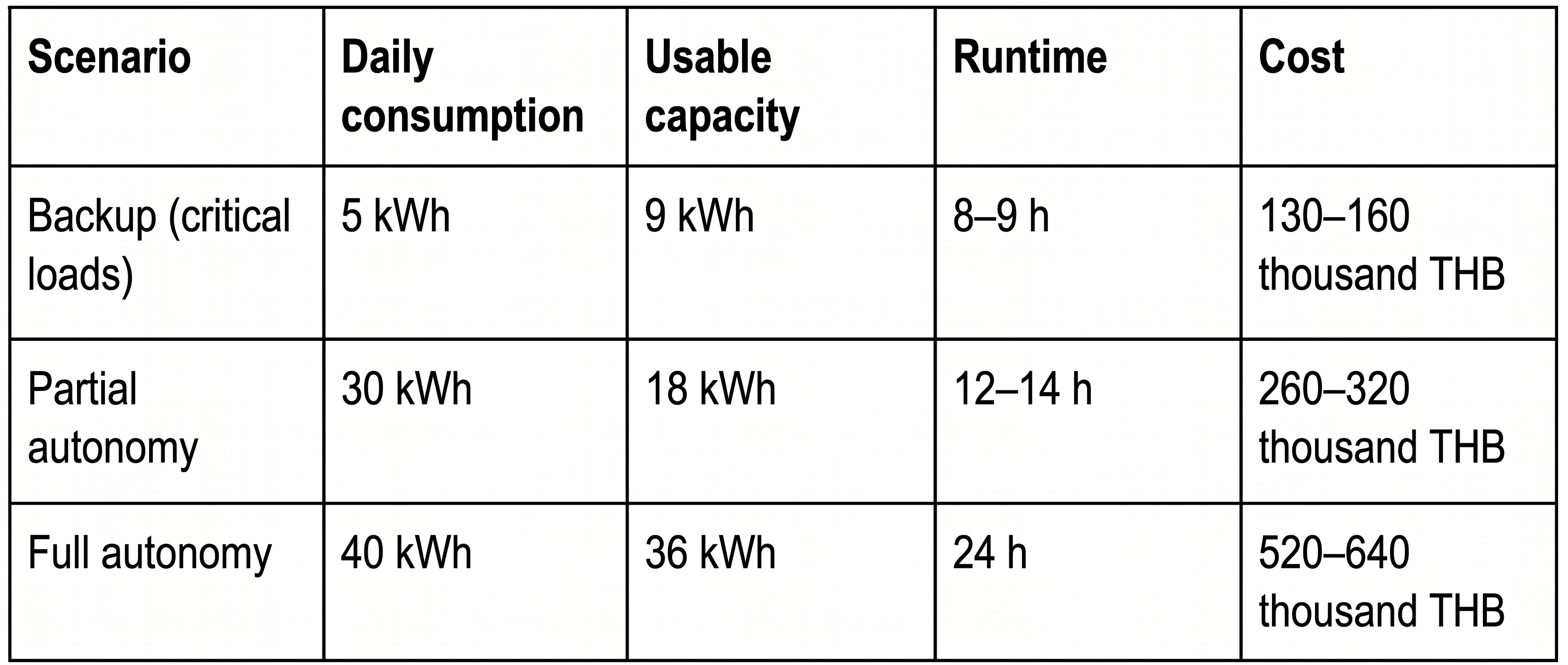
*The costs are calculated based on market prices of lithium iron phosphate batteries in Thailand (13,000-16,000 THB per 1 kWh). This does not include inverter, installation, VAT, switching and protection equipment.
As the table shows, full-day off-grid operation for an average villa requires a battery with at least 36-40 kWh of capacity, which would cost around half a million baht. However, this capacity is excessive for energy management – which is the main economic purpose of a battery. That is why such an investment pays back slowly.
A smaller battery costs significantly less. In case of a grid outage, it can supply critical loads for several hours while maintaining comfort in the house. And what’s important for your wallet, it helps reduce electricity costs by increasing self-consumption, shaving peaks, and making better use of TOU tariffs. With a proper analysis of the facility’s energy consumption and an accurate calculation of the required capacity, such a battery can shorten the payback period instead of extending it.
That is why batteries are rarely purchased for full energy independence. In a hybrid system, a battery is a tool for energy management. Its value comes from several factors: lower electricity bills, maintaining normal living conditions during grid outages, protecting equipment, and reducing risks associated with grid instability.
What determines battery economics?
Storage cost
The lithium-ion battery market is developing rapidly. In 2025, the average cost of energy storage systems is 150-250 USD/kWh for commercial installations and 250-400 USD/kWh for residential systems.
Lifetime
Under perfect conditions, lithium iron phosphate batteries (LiFePO₄) can operate for 15-20 years and withstand 6-10 thousand charge-discharge cycles. Service life increases with moderate charge and discharge currents and a limited depth of discharge (around 80%). The faster the battery is charged and the deeper it is discharged, the faster the cells degrade. High temperatures also accelerate degradation. The typical manufacturer warranty is 10 years. Lead-acid batteries are cheaper but last only 3-5 years, and its recommended discharge depth is only 50%.
Efficiency and losses
Lithium-ion systems have high round-trip efficiency: 90-95% of the energy passing through the battery is returned. This means that 5-10% of energy is lost in each cycle. With daily use, a 10 kWh battery will lose about 0.5-1 kWh per day.
Economic feasibility
Using a battery is economically justified when it reduces costs by more than its total cost over its lifetime. This includes reducing demand charges, benefiting from TOU tariffs, increasing available output power and balancing phase load imbalance, increasing self-consumption, and providing backup when the cost of outages (spoiled goods, equipment downtime, missed customers, and reputational losses) exceeds the cost of the battery.
In most residential cases without TOU tariffs, a battery pays back over 10-15 years and primarily serves for comfort.
Limitations to keep in mind
Limited capacity
As shown in the calculations, even a 20 kWh battery covers only half of a villa’s daily consumption. Businesses operating around the clock require hundreds of kWh.
Dependence on solar resource
On cloudy or rainy days, solar generation decreases and the battery is quickly depleted. Without grid or generator support, any system will eventually shut down.
Integration complexity
A hybrid system requires a hybrid inverter, load management system, and monitoring. Incorrect installation or underestimating peak demand can lead to system failure.
Conclusion
In modern hybrid solar systems, batteries reduce peak power demand, allow loads to be shifted from expensive hours, increase the share of solar self-consumption, and provide backup power in case of grid outages. The engineering and economic logic of using batteries in grid-connected solar systems is simple: a battery is an optimization tool, not a source of uninterrupted power.
Although battery prices remain high, their proper use does not necessarily increase the payback period – in many cases, it actually helps shorten it. It depends on how the battery is integrated into the facility’s energy system. When designing a system, Siriteja engineers carefully analyze the consumption profile, peak loads, and tariff structure to select the battery capacity that works for energy optimization. This approach allows the battery to become a tool for real savings, rather than just an expensive backup.
Request a consultation
Tell us about your property: number of buildings, approximate size, and your goals for autonomy and comfort. We will propose a solution with clear KPIs and no unnecessary engineering complexity.