TOPCon vs PERC: Which Solar Panels Should You Choose for Your Villa?
If you're seriously considering a solar installation for your villa in Phuket, you're bound to run into the terms PERC and TOPCon. These are the two mainstream types of solar panels on the market today, and they differ in performance, tolerance to heat and humidity, degradation rate, and price. Below, we compare the two technologies and help you decide.
In Plain Terms: What's the Difference?
Few readers will get much out of the technical details of how PV modules are built, but we'll leave them here for the truly inquisitive.
A PERC (Passivated Emitter and Rear Cell) cell is built on p-type silicon and features a passivated rear layer of aluminum oxide, which reduces recombination losses and improves light reflection.
TOPCon (Tunnel Oxide Passivated Contact) uses n-type silicon, a thin tunnel oxide, and a polysilicon contact layer. This structure cuts recombination losses even further and also delivers high bifaciality.
Put simply, every solar panel is made up of several layers, and the whole point of this construction is to boost output and minimize energy losses. The two module types differ in their materials and internal structure. PERC is a mature but retiring technology; TOPCon is the current industry standard — better on most counts, for a marginally higher price.
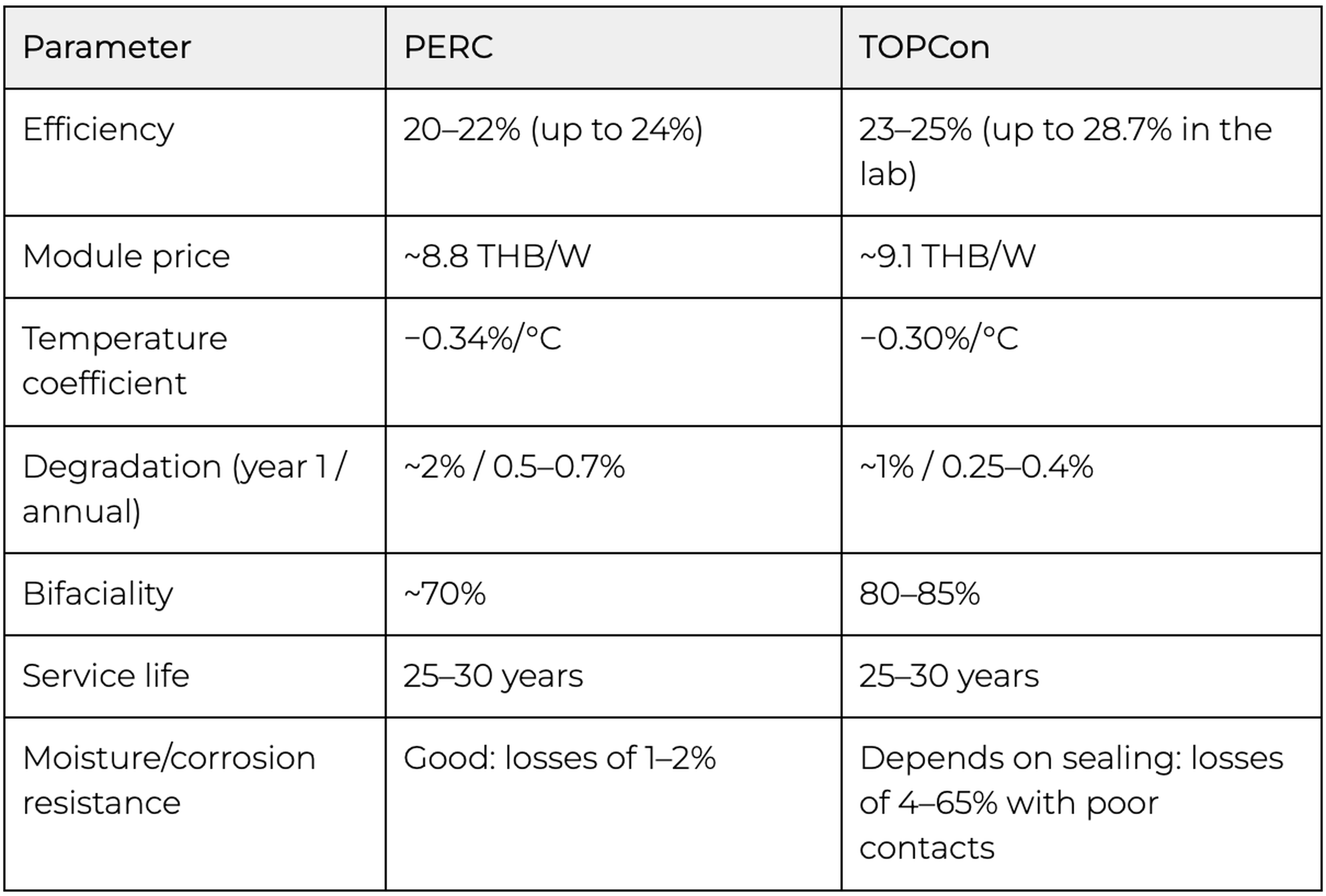
Here are the main pros and cons of each, followed by a comparison table.
PERC
Pros:
+ Relatively low price
+ A proven technology with an extensive track record worldwide
+ Performs well in diffuse light and partial shade
+ Highly resistant to moisture and corrosion
Cons:
− Lower efficiency
− More vulnerable to heat
− Faster degradation (a gradual loss of output, especially in the first year of operation)
TOPCon
Pros:
+ Higher efficiency
+ Better heat tolerance
+ High bifaciality (the rear side contributes to generation)
+ Slower degradation
Cons:
− More expensive
− Weak moisture protection in some models (tests have shown power losses of anywhere from 4% to 65% where the sealing is poor)
− Requires strict quality control during manufacturing (cheap, unbranded modules can degrade quickly in the tropics)
Comparison Table
Practical Considerations
Efficiency and Temperature Coefficient
The more efficient the system, the less roof area it needs. For a 10 kW villa system, for example, you'd need roughly 40 PERC panels at 250 W each, or 36 TOPCon modules at 280 W.
In Phuket, where temperatures regularly climb above 30°C, PERC panels can lose 3–5% of their output. Under the same insolation, TOPCon panels — with their better temperature coefficient — deliver a more stable yield.
Bifaciality
Bifaciality is a PV module's ability to generate power from its rear side. On villas with a white roof, a light-colored terrace, or concrete paving, reflected light reaches the array from behind and boosts total generation by 5–15%. PERC panels have a bifaciality of around 70%; for TOPCon it's 80–85%.
To get the most out of bifaciality, panels are mounted on a raised structure. Painting the roof white helps, too.
Moisture and Corrosion Resistance
In high humidity, PERC delivers more consistent results. TOPCon panels need quality sealing, dual-glass construction, and corrosion-resistant aluminum frames and mounting hardware. Regular maintenance matters as well — cleaning off salt and grime.
Degradation and Service Life
PERC panels degrade by 2% in the first year and by 0.5–0.7% annually after that. TOPCon loses about 1% of its output in the first year and 0.25–0.4% in the years that follow. Over 25 years, the cumulative difference in generation can reach 10–12%. In payback terms, that makes TOPCon the better investment — especially when the system is paired with batteries and an EMS.
Cost and Payback
Because it's more complex to manufacture, TOPCon costs 3.6–5.5% more than PERC. In a hybrid setup with LFP batteries and an EMS, that price premium can pay for itself through higher overall system efficiency and a smaller footprint on the roof. For budget projects, though, PERC remains a perfectly sound choice.
Half-Cell Technology and Panel Layout
In half-cell modules, the silicon cells are cut in two. This design copes better with partial shading, because each half has its own bypass diodes: even if a palm frond or a beam casts a shadow over one part of the panel, the other half keeps working at full output. Most modern modules of both types come in half-cell versions, and that matters for villas surrounded by trees or tall architectural features. Shade analysis and panel layout are best left to a certified engineer. The Siriteja Energy team runs these calculations on site, using climate data and 3D modeling.
The Climate in Phuket and Samui
Southern Thailand is hot and humid: average temperatures of 27–29°C, humidity of 72–83%, and a rainy season that runs from May to October and brings up to 2,200 mm of rainfall. High humidity and salt spray can corrode the system's metal components. That's why Siriteja recommends the following:
1. Choose panels with dual tempered glass and sealed contacts.
2. Use corrosion-resistant mounting systems — hot-dip galvanized steel or anodized aluminum alloys.
3. Mount the panels 15–20 cm above the roof surface for ventilation and natural cooling.
4. Design the system to withstand wind gusts and secure it with reinforced brackets.
5. Maintain the system regularly: rinse off salt, check the seals, and clear away leaves.
The Bottom Line: Which Is Right for Whom
The ideal case for TOPCon is a premium villa with high energy consumption and limited roof space. The technology really shines in hybrid systems: LFP batteries store surplus energy for use at night, while an EMS optimizes consumption. Stick to modules from reputable manufacturers with good sealing and corrosion-resistant frames.
If your roof has room for 10–20% more panels and the budget is strictly limited, PERC remains a viable option. However, given the minimal price difference, we now recommend TOPCon as the default choice, since the slight premium quickly pays for itself through higher generation.
Talk to Siriteja
Siriteja Energy designs and builds turnkey solar plants. We specialize in Southern Thailand, so we know the local conditions inside out. We work with the best manufacturers, keep our own warehouse in Phuket, and employ a team of qualified engineers with international project experience. We'll help you choose the right technology — TOPCon, PERC, or a combination of the two — and integrate LFP batteries and an EMS. Our free Siriteja Care program covers maintenance, monitoring, and system performance reviews.
Choose the right solar panels for your Phuket villa with Siriteja. Our engineer will calculate the optimal configuration free of charge and recommend the better option between PERC and TOPCon.
Request a consultation
Tell us about your property: number of buildings, approximate size, and your goals for autonomy and comfort. We will propose a solution with clear KPIs and no unnecessary engineering complexity.