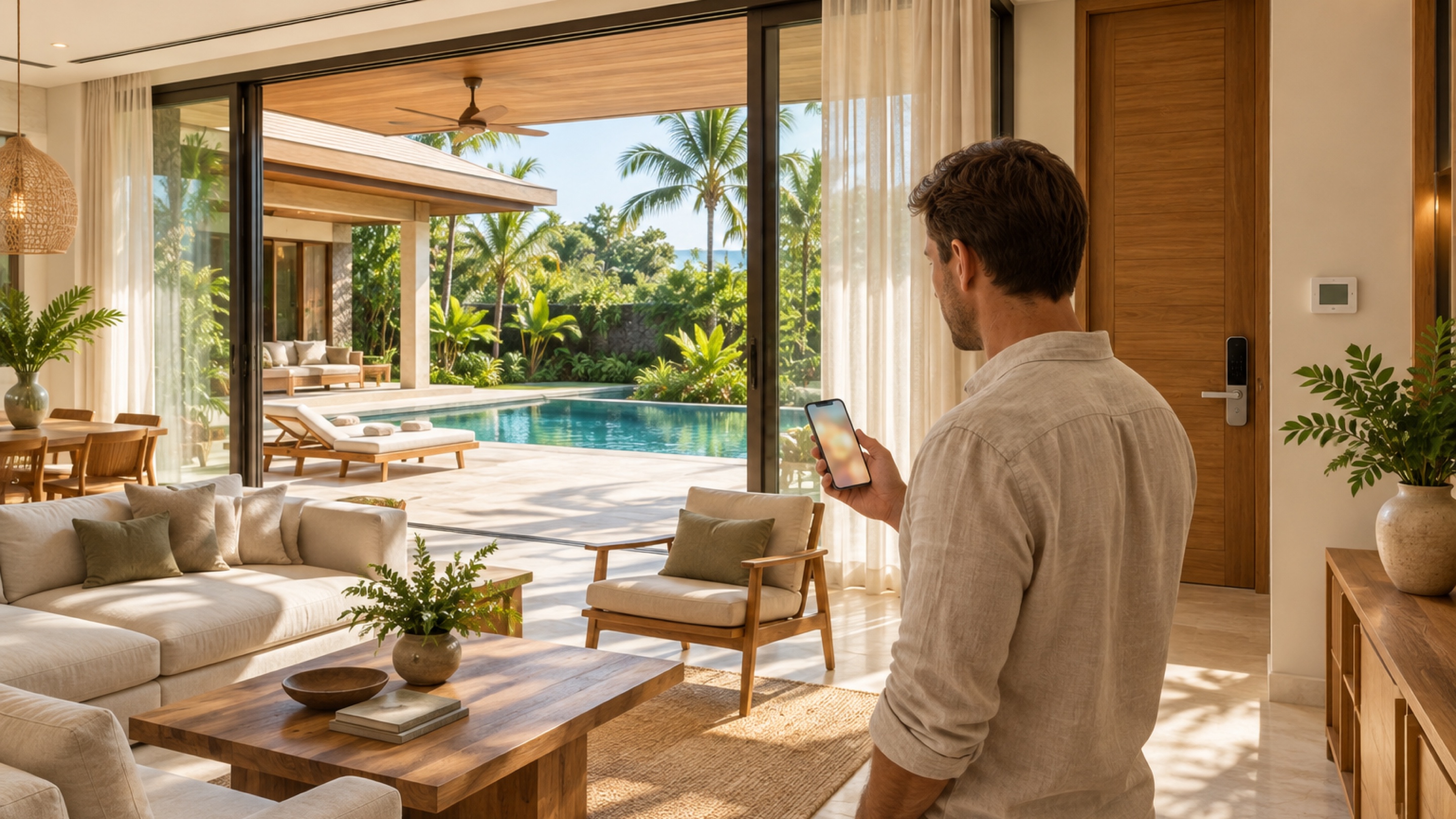
The Benefits of a Smart Home for Villa Guests and Owners in Southern Thailand
The market for villa rentals at tropical resorts keeps growing year after year, drawing in new players – which means it keeps getting more competitive. Guests have plenty to choose from, so owners and property managers are working to make their villas as comfortable as possible while also cutting operating costs. This is especially true in Southern Thailand, where electricity rates are high.
Against this backdrop, smart home systems are no longer a toy for tech enthusiasts – they are becoming an essential part of premium rental infrastructure. Smart lighting, climate control, security, and energy management improve the guest experience and make owners' lives easier at the same time. In this article, we'll look at how automation solves the practical problems of this market, and how it works together with solar panels and energy management systems.
What a Smart Home Is – and What It Isn't
The term “smart home” gets used very loosely, so let's agree on what we mean by it: an architectural approach to running a home in which the key building systems work in concert and are controlled from a single point. In other words, a few smart bulbs, smart plugs, or a voice-assistant speaker don't yet make a smart home. A smart home begins where there is unified control logic, scenes and automations, and remote access.
In engineering terms, a smart home ties together the following systems: lighting; climate (air conditioning and ventilation); security; sensors that monitor the state of the house; and automation that run the house without human involvement.
What Guests and Owners Want
Tourists come to a villa to relax and unwind, not to battle with the air conditioner. However hot and humid it gets outside, the house should always be comfortable inside – Ideally without anyone lifting a finger. Nor should operating the rest of the household equipment become part of the trip's memories. Nothing punctures the picture of a premium holiday quite like hunting for a light switch behind a dresser, or standing on a stool in a vain attempt to pull a curtain shut. Everything in the house that can be automated should be automated – check-in and check-out included. At the same time, guests expect their personal space and security to be respected. And those who care about the environment will be glad to know the house is saving electricity and water.
And what about the owners? For them, the energy spent on air conditioning is one of the biggest items in the operating budget. Without losing sight of guest comfort, they want to trim their electricity bills wherever possible. Like their guests, they want to keep hands-on management to a minimum: from check-in to check-out, the less human intervention a villa requires, the better. Predictable operation matters too: no unexpected breakdowns or household mishaps means no disputes with guests. And good reviews online are among the most important success factors in this market.
How a Smart Home Solves These Problems
Automated, centralized control of a home's systems gives guests a modern standard of comfort and security, while helping owners keep their bills in check, cut down on manual management, and prevent failures on the property.
Lighting
Smart light fixtures switch on when they sense motion, dim automatically at night, and turn themselves off in empty rooms. LED bulbs are cheap to run and last for years. Some hotels have cut their lighting costs by more than 75% simply by automating their lighting. Guests can choose a scene to suit the moment: bright light for working or an evening with company, soft light for winding down at night.
Climate
Smart thermostats continuously analyze sensor data and keep the temperature where it should be. They spot irregularities in HVAC performance early and flag the need for repairs before the air conditioner breaks down for good. Beyond uninterrupted comfort for guests, this reduces maintenance costs. The property manager can adjust the temperature remotely before guests arrive, or while they are out.
Security
Smart locks and digital keys let guests enter the villa without ever meeting the property manager, using individual codes issued for the duration of their stay. Once the stay ends, the codes are deactivated automatically. Video doorbells and motion sensors make it possible to confirm check-in, keep an eye on the perimeter, and prevent unauthorized entry. Noise sensors measure decibel levels without recording conversations, helping enforce quiet hours without intruding on privacy.
Remote Access and Control
A central controller brings together every device on the property. From a mobile app, the owner can see current energy consumption, battery status, the state of the locks, and the temperature. Automated scenarios such as Check-in, Check-out, or Cleaning can be run remotely. If an EMS is integrated into the system, it can also shift loads, switch off non-essential appliances, and manage the battery.
Scenes and Automation
These systems let you set up custom scenes and automations. A Night Stay scene, for example, turns on dimmed lighting, lowers the blinds, and brings the temperature down. Check-out cuts off all power sources, closes the blinds, and arms the alarm.
Integration with Solar Panels and an EMS
In Southern Thailand, installing solar panels is a logical step – but they deliver the most value when paired with a smart home and an energy management system.
An EMS (Energy Management System) is a technology that helps owners track, control, and optimize how energy is generated and consumed. The system analyzes how much energy the house produces and, guided by the owner's preferences, distributes it as efficiently as possible. Energy goes first to the house's own needs, then to charging the battery. Once the battery is full, the surplus can be fed back into the grid or routed to power-hungry appliances. If the grid goes down, the hybrid inverter automatically cuts the house off from it and switches to running on the batteries and solar generation alone.
Working in tandem with the smart home systems, the EMS schedules energy use automatically, adapts to the guests' routines and to the weather, and lets you watch generation and consumption in real time through the app. All of this happens invisibly to guests, leaving them free to enjoy their comfort, knowing the house is taking care of the environment on its own.
An EMS also makes the property's operation costs more predictable, and the solar installation pays for itself sooner.
What This Looks Like in Real Life
Before
Picture a villa in Phuket, fitted with standard air conditioners, ordinary light fixtures, and mechanical locks. Guests head off to the beach and leave the air conditioning running, driving up costs. A key goes missing, and an agent has to be called out. Frequent power surges and heavy loads knock out the air conditioner at the height of the season. The owner fields complaints. Solar panels are installed, but they run on their own, managing no loads: during sunny hours the battery sits full, and in the evening the house buys the maximum amount of electricity from the grid.
After
The owner has installed a smart home system paired with an EMS. The house now has thermostats, occupancy sensors, smart locks, microcontrollers, and solar inverters, all integrated into a single hub. At check-in, the guest receives a unique code on their smartphone and opens the door themselves. Two hours before arrival, the EMS switches on the air conditioning and cools the house to a comfortable 24 °C. When nobody is in, sensors shut off the climate control and the lights. The solar panels charge the battery, and the EMS pushes the washing machine's run to midday, when there is sun to spare. At night, appliances run on the battery. Predictive analytics gives early warning of possible compressor wear, so a service crew can overhaul the air conditioner in the off-season. In their review, the guest singles out the convenience, the quiet, and the eco-friendly approach.
Conclusion
When choosing where to stay for an island holiday, today's travelers increasingly expect digital comfort. If a competitor offers contactless entry, remote climate control, and clean energy, the absence of those options reads as a drawback. In a market saturated with properties, a smart home is a way to stand out without slashing prices. What's more, energy-saving technology extends the life of equipment and eases the load on the grid. Adding a smart home and solar power raises a property's value, because prospective buyers and renters are willing to pay for reliability, comfort, and sustainability.
CTA
Want to make your villa more attractive to renters? The engineers at Siriteja Energy will help you modernize your property, installing a smart home system, solar panels, and an EMS. Get in touch with us to discuss an energy audit, equipment selection, and the automation scenes that will turn your villa into a model of modern, comfortable, sustainable real estate.
Request a consultation
Tell us about your property: number of buildings, approximate size, and your goals for autonomy and comfort. We will propose a solution with clear KPIs and no unnecessary engineering complexity.