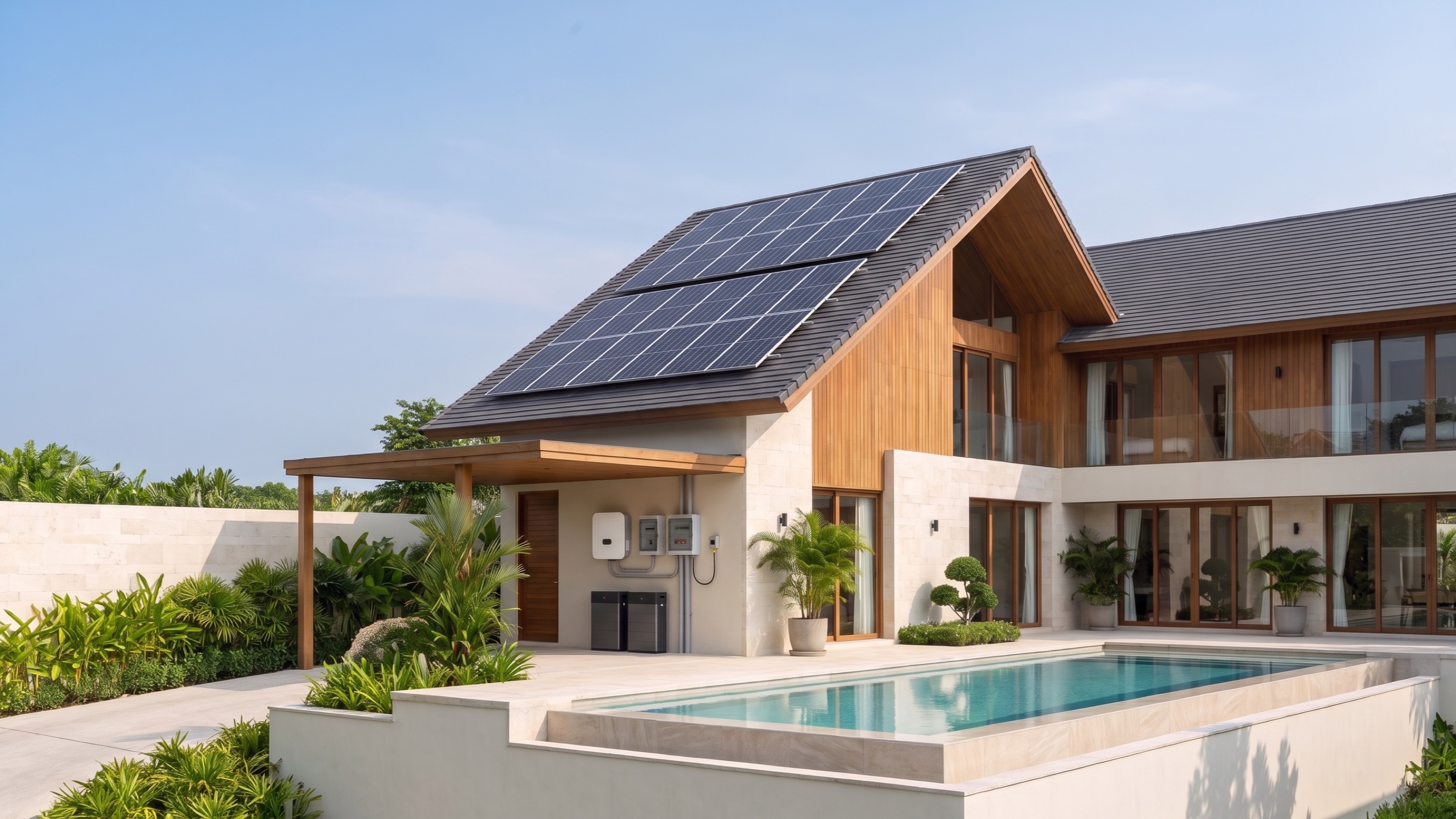
Solar + Battery + Backup + selling surplus electricity to the grid — can now be combined in one system under the PEA 2026 programme.
The page outlining PEA’s new rooftop solar program includes an important clarification from Thailand’s Energy Regulatory Commission (ERC).
At its June 24, 2026 meeting, the ERC officially confirmed that participation in the program does not prohibit homeowners from installing rooftop solar together with a Battery Energy Storage System (BESS).
That clarification significantly expands what these systems can do.
Previously, residential solar under programs like this could largely be viewed as a straightforward model:
Solar panels → self-consumption → export of excess power to the grid
Now, regulators have explicitly confirmed that a more sophisticated system architecture is permitted:
Solar → self-consumption → battery storage → grid
In other words, homeowners no longer have to choose between storing their excess solar energy in a battery and participating in a program that pays them for surplus electricity exported to the grid. The two can be integrated into a single system.
The practical benefits are substantial. Excess solar generation can first be stored for use in the evening or during a grid outage, while any remaining surplus can be exported. This increases solar self-consumption, reduces reliance on the grid, and makes the system valuable not only from a financial standpoint, but also as a source of backup power.
There are, however, important limits to the ERC’s clarification.
The ruling is not an unconditional approval of every possible BESS configuration. Battery installation and operation must comply with the technical requirements established by PEA or MEA. Nor does the clarification automatically mean that electricity previously stored in a battery can be freely discharged and sold back to the grid. Charge and discharge logic, as well as export limitations, must be properly incorporated into the system design.
Key program conditions
- Self-consumption remains the priority.
- The capacity registered for electricity sales is limited to 5 kW AC per electricity meter.
- The solar installation itself may exceed 5 kW, provided the additional generation is consumed on-site.
- The purchase rate for surplus electricity is THB 2.20 per kWh.
- Contracts run for 10 years.
- The combined PEA and MEA program quota is 500 MW AC.
- Applications are processed on a first-come, first-served basis, provided all required documentation has been submitted.
-
The broader significance of the ERC’s decision is that BESS now officially fits within the architecture of residential solar systems participating in PEA’s 2026 program.
That opens the door to more complete residential energy systems:
Solar + battery + backup + controlled export
rather than limiting homeowners to relatively simple on-grid installations designed primarily around surplus electricity sales.
For Thailand’s residential solar market, this is an important step. The battery is no longer merely an optional add-on to a rooftop solar installation. It can now be designed as an integral part of the home’s energy system.
Request a consultation
Tell us about your property: number of buildings, approximate size, and your goals for autonomy and comfort. We will propose a solution with clear KPIs and no unnecessary engineering complexity.