Seven Trends from SNEC 2026: Where Solar Energy Is Heading
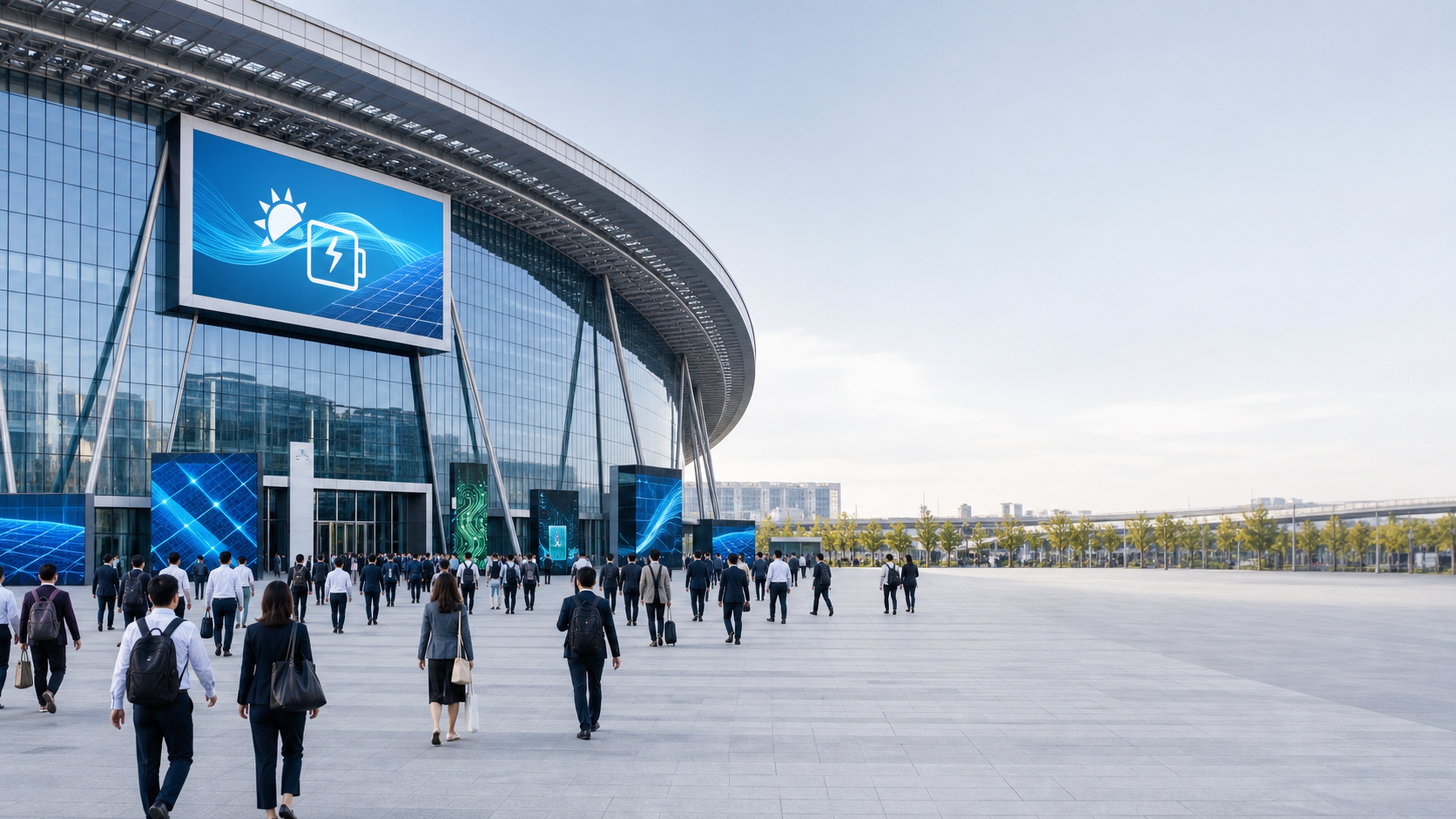
SNEC PV & ES Expo is the world's largest solar energy exhibition in Shanghai. In 2026 it drew more than three thousand companies and half a million visitors.
What makes an event like this worth watching is not so much any single product launch as the chance to see where the industry as a whole is heading – and that direction has shifted noticeably in recent years. Manufacturers used to compete mainly on panel output and battery capacity. That race still matters, but it is no longer the only one. Market leaders are paying increasing attention to how all this hardware is controlled, how safe it is, and whether it can operate as a single ecosystem. Panels have grown more efficient, storage has become safer and easier to install, the inverter has evolved from a simple converter into a control hub for the whole system, and artificial intelligence no longer just draws pretty output charts – it now handles genuinely practical tasks.
For owners of villas, hotels, and other commercial property in Thailand, all of this is highly relevant. On one hand, there is bright sunshine almost year-round; on the other, high electricity tariffs, huge air-conditioning costs around the clock, seasonal grid outages, and a rapidly growing fleet of electric vehicles. Together, all of this makes the solutions on display useful not at some point down the road, but today. What follows is our overview of the SNEC 2026 trends we found most significant.
1. Panels Become More Powerful, Efficient, and Better-Looking
Five years ago, a 400-500 W panel with 21-22% efficiency was the benchmark. At SNEC 2026, a module like that already looks dated. Panels in the 700-825 W range have become mainstream, and the efficiency of production modules has climbed toward 26%. These figures come from a move to larger G12 wafers (210 mm), quarter-cut cells (lower current and smaller losses in each segment), and denser cell packing.
For commercial sites, this means more generation from the same roof area. Far fewer modules are now needed, which lowers the cost of installation, cabling, and mounting structures.
TOPCon – a technology that went from promising to mainstream in just a couple of years – is now displacing PERC. Jinko's Tiger Neo 5.0 panels shown at the event, for example, deliver 700 W at roughly 25.9% efficiency.
HJT (heterojunction) modules add an ultra-thin layer of amorphous silicon on top of conventional silicon to cut internal losses. They cost more, but their lower temperature coefficient means they lose less output in the heat – which matters in the tropics.
One development that is easy to miss amid the race for higher output is ultra-light reinforced modules. The JinkoSolar Light Diamond delivers 560 W at 24.94% efficiency. Measuring 1.7 × 1.1 m with a reinforced frame, it weighs about 7 kg/m² – nearly a third less than a standard panel – thanks to ultra-thin 1.6 mm glass. Panels like these open up solar for roofs that simply could not have borne a system before: lightweight roofing, light industrial buildings, and retrofit projects.
For villas in particular, BC (back-contact) modules deserve a mention: all the busbars are moved to the rear of the cell, so the panel is fully black, blends neatly into the architecture, and copes better with partial shading from leaves or branches. The frameless TCL Zhonghuan C3 BC, for instance, produces 710 W at around 26% efficiency.
2. The Battery Is No Longer Just a Backup
Storage systems keep growing in capacity, most visibly in the commercial segment. The Shanghai show was full of systems of 6.25 MWh and up, rated for 8-10 hours of discharge. This is achieved mainly by scaling up cell capacity to as much as 1,300 Ah – as in Hithium's ∞Power container.
What does this change in practice?
A hotel can shift a large share of its daytime solar generation into the evening, when restaurants, lighting, and air conditioning are running, and so cut out the most expensive hours. For commercial sites, the battery becomes a tool for managing tariffs and peak loads.
Safety has improved along the way: manufacturers are betting on liquid cooling, multi-stage fire suppression, and a service life of 8,000-12,000 cycles, which for LFP chemistry already approaches decades of operation.
Residential homes are affected from a different angle. Bulky battery cabinets are giving way to modular "tower" systems – the Sigenergy SigenStor, Dyness Tower T17, and GoodWe ESA. These are tidy vertical stacks built up from blocks: with Dyness, for example, five modules provide 17.76 kWh, while a Sigenergy stack assembles in fifteen minutes thanks to quick-release connectors. Capacity can be added gradually as consumption grows. A welcome bonus for Thailand: many of these towers carry an IP65-IP66 rating and can be installed outdoors, saving space inside the house, standing up to the weather, and can even survive brief flooding – no small thing for the rainy season.
3. The Inverter Is Becoming the Brain of the Energy System
The inverter was long the dullest part of any system: its job was to convert the DC from the panels into AC, and that was that. At SNEC 2026, inverters turned out to be the most dynamic and interesting category of all.
A modern hybrid inverter conducts the panels, battery, grid, backup supply, and EV charging all at once – and increasingly does things that used to be the preserve of utility-scale power. Where earlier inverters merely followed the grid, today's devices can form voltage themselves: creating virtual inertia, supplying short-circuit current, and performing a black start. Huawei presented its FusionSolar 9.0 platform with a 460 kW string inverter, while Sungrow showed its PowerMatrix architecture, which stabilizes voltage within milliseconds. In practice, this means a site can build its own microgrid and run reliably off-grid.
For hotels, restaurants, and cold-storage warehouses in Thailand, this may be one of the most valuable trends of the coming years. Where a grid problem once forced a site to fall back automatically on a diesel generator, a modern inverter can hold up the local energy system on its own – more quietly, more cleanly, and without fuel.
4. Artificial Intelligence Finally Gets to Work
In 2026, practically every booth has "AI" written on it, which naturally invites some skepticism. Strip away the marketing, though, and it is clear that artificial intelligence in solar now has genuinely down-to-earth use cases. A few years ago, a "smart app" would at best draw a few nice generation charts. Today the system analyzes the weather forecast, consumption habits, tariffs, and the state of the battery – and makes decisions based on the data.
Sigenergy's AI agent (SigenAgent), for example, can optimize charging and discharging around dynamic tariffs and even take part in energy trading. There is a storm-preparation mode: on receiving a storm warning, the system charges the battery to 100% on its own and readies the home to island from the grid. Huawei has built a layer into FusionSolar that predicts equipment failures and optimizes MPPT tracker operation. Several manufacturers use the same algorithms to assess cell health, so the system can flag a cell's degradation long before it actually fails.
Some of the louder promises – "full autonomy," self-cleaning panels – still await real-world proof. But in diagnostics, charge/discharge optimization, and energy-market participation, the benefits are already tangible.
5. Standalone Components Give Way to Ecosystems
Solar systems used to be cobbled together from a mix of brands – panels from one maker, the inverter from a second, batteries from a third. Integrating it all was a demanding engineering job. At SNEC 2026, a new trend is clearly visible – vertical integration. Manufacturers are working to offer a complete ecosystem in which the panels, inverter, storage, energy management system (EMS), EV charging, and software all behave as a single product.
Tellingly, panel makers are launching their own storage and inverters (JinkoSolar has introduced the SunTera storage system, and Trina is developing its TrinaStation platform), while inverter makers such as Huawei and Sungrow are releasing "smart" modules with built-in electronics.
The benefit for the owner is straightforward: when a single supplier is responsible for the whole system, you avoid the classic situation where, after a failure, the vendors point fingers at one another and the warranty claim is left hanging somewhere between them.
6. Solar and EVs Increasingly Go Hand in Hand
Solar generation is no longer considered separately from charging infrastructure. The electric vehicle is steadily becoming the single largest electricity consumer in the home, and leaving it out of the system design is simply impractical. New inverters and EMS platforms are therefore increasingly designed as a single control center for the panels, battery, and EV charging. Deye's integrated MSLC430, for instance, combines 430 kWh of storage with 180 kW of charging modules.
For a villa, this is a reason to design future car charging into the project from the start; for a hotel, it is a chance to offer charging to guests as a service.
7. Perovskites Edge Closer to Reality
The most striking exhibits at the show are, of course, not the ones you can buy today but the ones set to reshape the industry over the next couple of years. The headline story of 2026 is the perovskite-silicon tandem module. The idea is to place a thin perovskite layer on top of a conventional silicon cell to capture the part of the solar spectrum that silicon uses poorly. The combined result is impressive: Trina Solar showed a 907 W tandem module at 29.2% efficiency, certified by TÜV SÜD, while GCL claimed a laboratory record of 30.23%. Not long ago, 22-23% counted as a very good result.
For now, though, these remain show and pilot units. Manufacturers still have to prove their durability and make the economics work – Trina expects mass production in two to three years. But the fact that the industry has come right up to 30% efficiency matters: it shows that silicon, which seemed to have hit its ceiling, still has room to grow.
What of This Will Really Pay Off in Thailand
Not every technology on display applies equally to southern Thailand – the local climate and tariff structure set their own priorities. Over a three-to-five-year horizon, a few solutions look the most promising.
For villas and private homes, it makes more sense not to chase giant panels but to choose mid-size modules (400-500 W) on TOPCon or HJT, with a good temperature coefficient and strong resistance to degradation. BC modules add aesthetics to the equation, which on a villa is often the deciding factor. Pair them with a 5-20 kW hybrid inverter with full backup power and a 5-16 kWh LFP battery, most conveniently in the modular "tower" format. AI control (SigenAgent, the GoodWe WE Platform) will help match consumption to tariffs and user behaviour.
For hotels, the logic is different: powerful 650-700 W TOPCon/HJT modules on roofs and carports (bifacial ones also capture light reflected off bright surfaces), container storage of 6-6.9 MWh for the evening peak and backup, and grid-forming inverters for uninterrupted operation. The AI platform takes on the most troublesome part – the uneven consumption profile: it ties air conditioning, kitchens, the laundry, and the evening restaurant peaks to panel output and battery charge, smooths out the expensive hours, and adapts to swings in occupancy, lowering the bill without staff having to keep watch by hand.
For warehouses, factories, and data centers, the priorities become 5-10 MWh systems, integration with EV charging, grid-forming capability, and AI control, along with stricter safety requirements – liquid cooling and multi-stage fire suppression.
If we try to sum up the main point, the takeaway from SNEC 2026 lies in no single technology. The industry is gradually moving away from the familiar picture of "panels on a roof" toward the idea of a whole energy system that manages generation, storage, and consumption on its own. The individual components have not gone anywhere and keep improving – but value is shifting, ever more visibly, from the hardware to how intelligently it is tied together. That, in all likelihood, will be the defining change in solar energy over the coming decade.
Request a consultation
Tell us about your property: number of buildings, approximate size, and your goals for autonomy and comfort. We will propose a solution with clear KPIs and no unnecessary engineering complexity.