Off-grid power systems: when a home runs without the grid
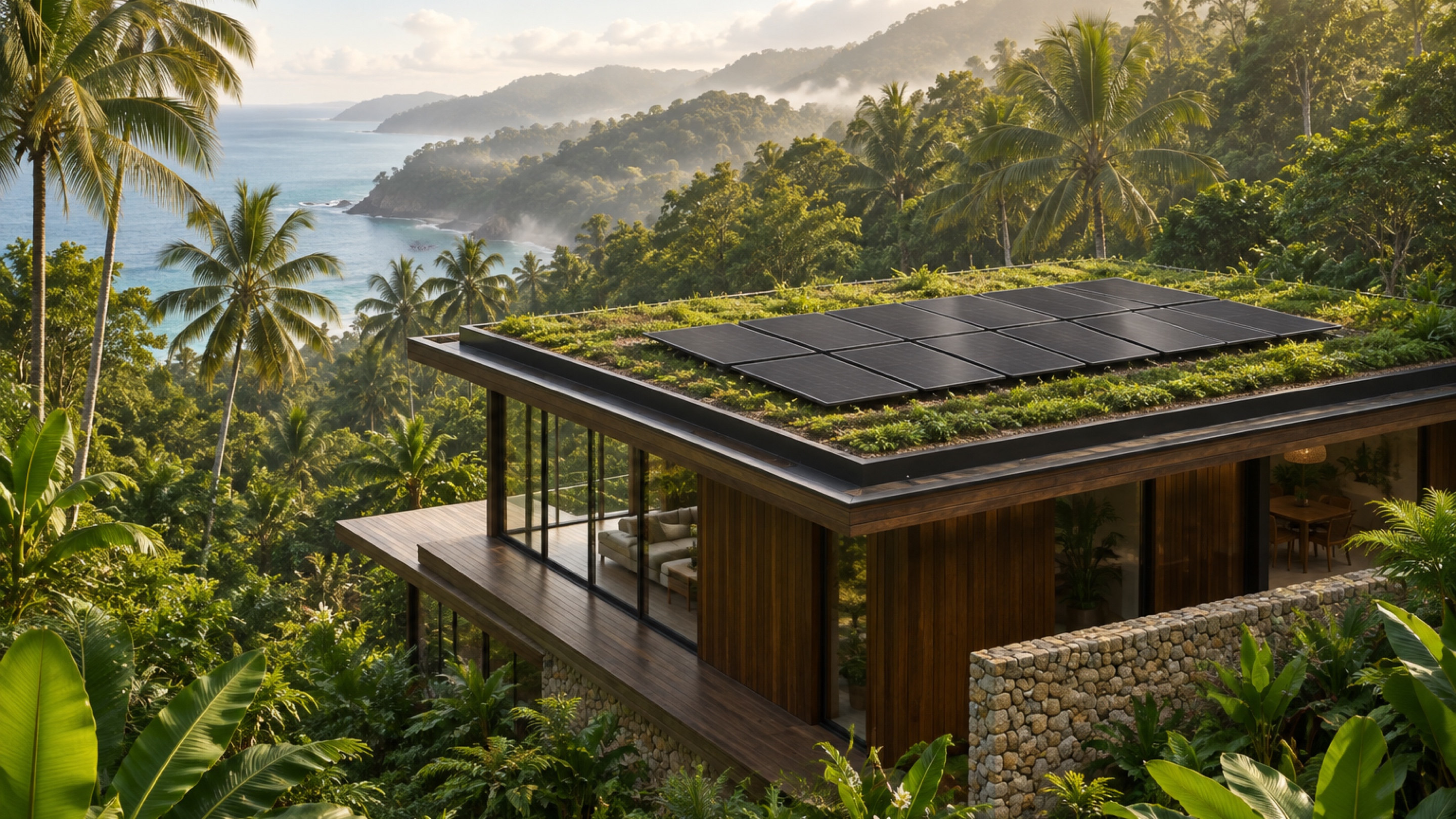
Who hasn’t dreamed of a picturesque little house tucked away in the jungle, far from civilization – maybe even on a desert island? Well, from an engineering point of view the dream is achievable, if you are willing to work at it. In this article we explain how houses that supply their own electricity are put together, what is required of them, and when the whole exercise is genuinely worth it.
Off-grid is a class of power system in its own right, one where responsibility for the electricity – from the bedroom light to the pumps and the air conditioning – rests entirely with the system itself. These systems are completely separated from the central grid. Design one wrong and there is no electricity. Off-grid is therefore engineering under hard constraints.
What off-grid actually means
In engineering terms, off-grid means an isolated power system with no connection to the national or local electricity network. It has to keep every load supplied around the clock, on its own. Its primary energy sources are usually renewable, which makes them subject to seasonal and weather-driven swings. The system has to handle bad weather, peak loads, and equipment failures without outside help.
How does off-grid differ from hybrid and backup systems?
Hybrid – the grid is there; the battery and the solar panels only reduce how much you depend on it.
Backup – the system kicks in during outages, but it is not built to run all the time.
Off-grid – there is no grid at all. And there never will be.
The basic architecture of an off-grid system
A basic isolated power system has five components (we will leave exotica such as wind turbines or hydrogen fuel cells aside here).
1. Solar panels convert the energy of sunlight into direct current through photovoltaic cells. PV panels are the cornerstone of an off-grid system.
2. Battery storage smooths out daily swings in consumption and covers short-term shortfalls.
3. The inverter converts the direct current from the battery and the panels into the alternating current that household appliances run on.
4. The backup generator supplies power when solar output falls short and the battery is low. It is not an optional extra but a mandatory part of a reliable off-grid system.
5. The control and monitoring system tracks the state of charge, manages generator starts, and oversees the protective devices. Remote monitoring lets service engineers spot faults before they turn into problems.
Removing any one of these components means knowingly making the whole system less reliable.
Solar panels: the primary source of energy
Solar panels are the primary source of energy in a standalone system. What they generate has to cover average daily consumption and recharge the battery. The recommended ratio of PV array output to average consumption (array-to-load ratio, ALR) is at least 1.3 – that is, the panels should produce at least 30 percent more electricity than the site uses.
When sizing an array, you have to allow for spells of bad weather – cloudy and rainy days. The right approach is to design for the darkest month of the year, so that the system does not run short in winter. Off-grid installations often take up 10 to 40 percent more space than grid-tied ones.
Batteries: storage, not a source
In a grid-tied system the battery acts as a buffer. In an off-grid system it has to cover two to five days of consumption with no solar generation at all, so the storage capacity is usually far larger than in grid-tied systems. A separate battery room is normally required.
One point worth being clear about: although off-grid batteries are sized for several days of autonomy, they are not meant to run routinely in a prolonged energy deficit. Their job is to smooth out daily swings, not to stand in for generation days on end. When solar output is missing for a long stretch, the backup generator takes over.
Battery selection turns on more than nominal capacity: the usable depth of discharge (DoD) matters just as much. Modern lithium iron phosphate (LiFePO₄) batteries tolerate deep discharge down to 80-95 percent and last 3,000 to 7,000 cycles.
Temperature affects capacity and service life as well: cold reduces the capacity available, heat shortens the life of the cells. The charge controller has to take temperature into account while charging; if it does not, the batteries wear out sooner and safety problems become possible.
However large the battery bank, the energy budget in an off-grid system is finite. Owners end up planning when they use their appliances and shifting the power-hungry ones to the sunny hours. The battery is the first line of defense, then, but it does not deliver absolute autonomy through long sunless stretches.
The role of the backup generator
In an off-grid system the generator is mandatory.
It does several jobs at once:
· It covers the energy shortfall in bad weather. Off-grid systems depend on a variable solar resource. When irradiance is low and consumption outruns charging, the generator starts.
· It handles peak loads. The generator also covers high instantaneous loads that were left out of the calculations, and keeps the power on when heavy equipment is plugged in – a power tool, a pump, an electric car. The backup source is a “second layer of protection,” and it has to start before the battery is run down too far.
· It insures the system against equipment failures. If the link between the panels and the battery breaks, if the inverter fails, if something goes wrong inside the battery – the generator is what keeps the critical loads alive.
· It preserves battery life by keeping the cells out of deep discharge. To avoid running the storage down to dangerous levels and cutting its service life short, the system needs a backup generator.
Generators run on diesel, LPG, or gasoline. Diesel is usually the most dependable choice: it is easy to transport, energy-dense, and it works reliably in any climate. Keeping a generator running without interruption means keeping fuel and oil in stock and servicing the machine on schedule. That costs money, especially in remote areas. Noise and emissions are worth weighing when you choose a model.
The idea of “all-solar” autonomy is appealing, but in practice doing without a generator almost always ends the same way: either consumption has to be cut back sharply, or the system starts operating outside its permitted limits.
Common mistakes in trying to go off-grid
· Undersized battery capacity, calculated for ideal conditions only. The battery bank has to provide two to five days of autonomy.
· Underestimating the climate – humidity, heat, seasonal rains. Designers often work from annual average irradiance figures and ignore the seasonal swing. The system should be sized for the worst month; otherwise an installation that looks adequate in summer will fall short in winter. Temperature effects matter too: cold cuts capacity, heat accelerates battery aging. On islands and in mountain regions the climate can change abruptly, so batteries have to be chosen with a suitable temperature range.
· Trying to manage without a generator. Many owners are set on “full solar autonomy” and do not want a generator on site. It saves on upfront cost, but it brings the risk of deep discharges, particularly in winter or through long spells of bad weather.
· Underestimating how much solar capacity is needed. Clients look at average power and forget about peak loads and seasonal variation. The array should be oversized by roughly 30 percent relative to average consumption.
· No service strategy. Standalone systems need regular maintenance: checking connections, checking battery condition, testing the generator, cleaning the panels. In practice, though, service is often left out of the budget. Fuel and oil for the generator have to be on hand at all times, and routine maintenance is what prevents failures. The supplier needs a strong service network that can get spare parts and technicians out quickly; without one, a repair in a remote location will take weeks.
These mistakes rarely show in the first few months, but after a year or two of operation they almost always do.
When off-grid really does make sense
Off-grid solutions are justified where a grid connection is technically impossible or economically pointless. On islands, in mountain regions that are hard to reach, or deep in the jungle, running transmission lines is often impossible or costs more than the power system itself. In Thailand, where many islands and resort villas sit far from the centralized grid, off-grid systems make energy independence possible.
Where the grid is available and reliable, off-grid rarely pays: the capital outlay is high (panels, battery, controller, inverter, generator) and so are the maintenance costs. A standalone system also takes up more space and carries a heavy bill when the batteries need replacing. In that situation the sensible choice is a hybrid setup with a grid connection and backup.
Siriteja’s approach to off-grid projects
On off-grid projects we start from the site’s actual load. Our approach involves:
· Sizing from the consumption profile rather than from the hardware. Design begins with a detailed energy audit: several weeks of measurement, sorting critical loads from non-critical ones, accounting for inrush currents. Only then do we select panel capacity, battery capacity, and generator rating. The battery calculation factors in daily consumption, the number of days of autonomy, the permitted depth of discharge, and inverter efficiency.
· Scenario-based design. We work through, the bad-weather case, the arrival of guests, and the failure of a component.
· Building in margin, both in capacity and in service life. The whole system is designed with headroom: oversized cabling and protection prevent overheating, batteries are chosen with cycle life to spare, and the panels are sized for the worst season. The generator is rated for maximum starting loads and comes with several weeks’ worth of fuel on site.
· Mandatory support after commissioning. Siriteja provides remote monitoring, scheduled maintenance, and operator training. The strategy covers a generator inspection schedule, testing of the automation, and software updates. An off-grid system does not end at installation. It calls for constant oversight and an understanding of how the site lives and uses energy.
Conclusion
Off-grid solutions call for discipline in design, headroom in the equipment, and a clear-eyed view of the limits. That is why off-grid remains a niche solution. Handled with respect for the difficulty of the task and a grasp of the climatic and logistical factors, though, off-grid projects can be a dependable answer for islands, remote villas, and infrastructure sites. For homes and businesses with grid access, hybrid or grid-tied solutions usually make more sense.
Request a consultation
Tell us about your property: number of buildings, approximate size, and your goals for autonomy and comfort. We will propose a solution with clear KPIs and no unnecessary engineering complexity.