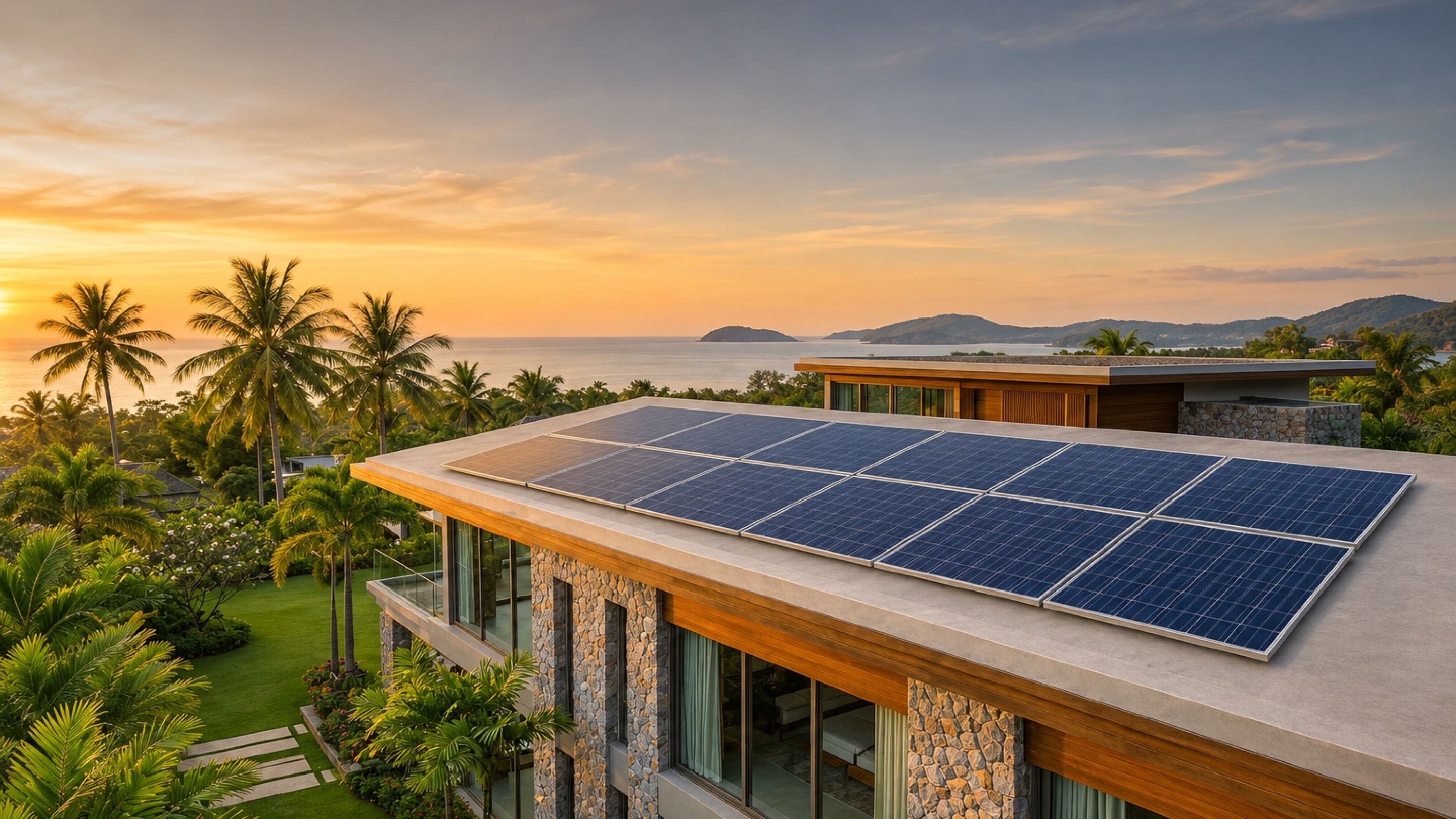
New Rules for Solar Power Systems in Thailand: What Changes for Property Owners in 2026
Thailand is updating its rules for connecting solar power systems to the grid and making certification mandatory for solar panels. Let’s break down which changes are already in force, which take effect soon, and what they mean for new and existing installations.
Two major changes in one year
Fall 2026 brings two regulatory changes to the solar sector at once. The first sets new equipment requirements: as of October 30, crystalline silicon solar panels can be manufactured, imported, and sold in Thailand only if they meet a mandatory national standard. The second concerns grid connection. The Provincial Electricity Authority (PEA), which serves Phuket, Koh Samui, and nearly the entire country outside Bangkok, has updated its Grid Code, the set of technical rules for anyone who connects power generation to its network. On December 10, the new code will replace the 2016 rules.
These are two separate documents from two different agencies, but for the owner of a house, villa, or hotel, the upshot is the same: the requirements for a solar system are getting stricter.
Starting October 30, 2026: a mandatory TISI standard for solar panels
The standard itself, TIS 61730 Part 2-2567, predates the new rule. According to TISI, it has been in effect since June 13, 2025, and is equivalent to the international IEC 61730-2:2023. Until recently, though, compliance was voluntary. On October 28, the Minister of Industry signed a ministerial regulation that makes the standard mandatory. The Royal Gazette published the paper, and it has been in force since October 30, 2026. It covers crystalline silicon modules, except for panels built into other products.
The standard sets out safety requirements: heat resistance, protection against current leakage and electric shock, behavior under reverse current and localized overheating, resistance to fire spread, and mechanical strength. Manufacturers and importers must obtain a TISI license, and sellers may offer only licensed products. Importing without a license is punishable by up to two years in prison or a fine of up to 2 million baht. Selling non-compliant panels can bring up to six months in prison or a fine of up to 500,000 baht.
For buyers, the key takeaway is this: a well-known brand and an international IEC certificate no longer prove, on their own, that a particular panel can legally be sold in Thailand. As analysts point out, a TISI license is tied to the importer, the specific factory, and the model range. If another company starts importing the same panels, it has to obtain its own license. An international IEC certificate speeds up licensing but can’t replace it. Products must carry the TIS mark and a QR code, and the license can be checked in the TISI database. According to the ministry, 259 licenses were already in place by the time the rules took effect.
PEA updates a Grid Code that dates back to 2016
PEA published the new Grid Code on September 10, 2026, and it takes effect 90 days later, on December 10. The package consists of four documents, and the key points are laid out in PEA’s official summary of changes. Many of the requirements depend on system size and voltage level. Here’s what matters most for residential and commercial systems:
• Inverters. Every inverter, regardless of size, must be able to adjust its power factor anywhere from 0.90 lagging to 0.90 leading and help support grid voltage in two ways: by supplying reactive power along a Q(U) (volt-var) curve and by reducing active power along a P(V) (volt-watt) curve. Systems above 50 kW face additional requirements for riding through voltage dips and responding to frequency changes. The inverter must also support Modbus over RS-485 and TCP (Wi-Fi or 4G) or connect through a gateway.
• Grid export. On the low-voltage network, the combined export of all customers connected to a single transformer is now capped at 25% of the transformer’s capacity, up from 15%. If a system’s installed capacity exceeds its permitted export, it needs an export limiting device.
• Monitoring and data. Systems above 1 MW must have a monitoring system and be able to receive commands from PEA’s dispatch center. PEA can also require real-time data from equipment such as the inverter, with the system owner covering the cost.
• Inspections. Once connected, equipment is subject to regular inspections, and PEA can limit a connection permit to a maximum of 10 years, after which the owner has to apply again.
What does this mean for home and villa owners?
Most residential systems are connected at low voltage and don’t exceed 50 kW. For these systems, the biggest change is the new inverter requirements. If you’re buying an inverter now, make sure the model supports volt-var and volt-watt modes and will pass testing under PEA’s new procedure. Inverters already on the approved list under the old rules can still be used in new applications until their registration expires, but no later than December 31, 2027.
The second big question is how much you’re allowed to export. The 25% cap on transformer capacity is shared by everyone connected to that transformer, so in a housing development or on a street with several solar rooftops, there may be almost no headroom left. Calculating export and configuring the limiter correctly are now a required part of designing the system.
This is where a battery really proves its worth. During the day, solar panels often produce more power than the house uses. If the surplus can’t be sent to the grid, or only a small amount can, the export limiter will force the inverter to cut its output, and some of that solar energy will go to waste. A battery stores the surplus and releases it in the evening, so when export is limited, a system with a battery makes far better use of what it generates.
Do existing solar systems need to be retrofitted?
The new rules don’t automatically require replacing any equipment. The TISI standard governs how panels are manufactured, imported, and sold, so it doesn’t apply to systems that are already up and running.
With the Grid Code, it’s more complicated. Owners whose systems were approved for connection before December 10, 2026, or whose applications are still under review, can stay connected until December 31, 2029. To remain on the grid after that, they need to submit a new application under the 2026 rules at some point in 2028. PEA does, however, allow previously approved equipment to stay in place as long as it doesn’t cause technical problems for the grid. Existing connections are also exempt from the new volt-var, volt-watt, and frequency response requirements. Any application that hasn’t been submitted with a complete set of documents by December 10 will be reviewed under the new rules.
What comes next?
Panels are just the first step. TISI is preparing mandatory standards for seven more component categories: DC cables, lithium batteries, fuses, inverters, DC circuit breakers, DC connectors, and junction boxes. No timeline has been announced yet.
How Siriteja Energy is preparing for the new requirements
We have started asking our suppliers for proof of TISI licensing and selecting inverters with the new Grid Code requirements and PEA’s approved list in mind. We also prepare the technical documentation for PEA and run tests when commissioning each system. If you’re planning a solar installation in Phuket, get in touch with Siriteja Energy. We’ll help you assess the technical requirements, choose the right equipment, and design a system that meets Thailand’s current regulations.
Request a consultation
Tell us about your property: number of buildings, approximate size, and your goals for autonomy and comfort. We will propose a solution with clear KPIs and no unnecessary engineering complexity.